- Call us Via Whatsapp: +84 (0) 832 126 699
4.9 stars on our site
(15,000 reviews)
- Monday - Sunday : 08:00 - 17:00
(15,000 reviews)

1. Cambodian Costume
Traditional Khmer dress goes back many centuries; little has changed. Prior to the Khmer Empire the style of clothing showed major Indian influence but gradually things changed. Fashion has come and gone but often tradition has been revived and today Cambodian clothing is both colourful and traditional. A good Cambodia travel agency will introduce visitors to the local costumes.
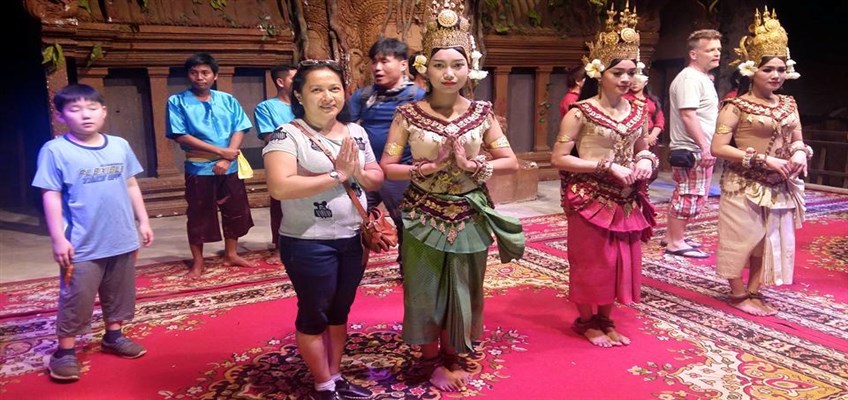
Cambodia tour packages provide an insight into the whole country and while rural life involves hard work each day, when there is a chance to celebrate at one of the festivals or annual events, the locals are only too happy to do so. They will dress in colourful traditional costume. Similarly, there are theme evenings within the City where performances of song and dance will also see the performers dressed in traditional Khmer clothing.
In terms of style. Little has changed over the years.
2. cambodian costume
• The Sampot, the national garment, are Cambodian ‘’bottoms’’ still commonly worn by ordinary men and women. It is similar to the sarong that those on Indochina tour packageswill see in neighbouring Laos and Thailand. They measure about a metre and a half with the two ends are sewn together to form a tube-like garment. There is a wide range of colour and the material varies depending on cost, and therefore social status.
• Chang Pongis a piece of fabric from the end of the 13th Century, primarily for women covering their chests, leaving the stomach uncovered. It evolved into Tronum, a strong fabric cover which hugged the body.
• Av Bumpong is a tube-like skirt which hangs loosely from the neck while Aor Bupok, nominally a shirt appears more like a dress.
• Clothing does vary with class; the wealthy women wear a traditional blouse buttoned down the front known as Av Dai Puon with a more formal top an alternative, Av Pnot Kbach.
• Av Pak is a modern fashion, a blouse made of cotton, hand painted and embroidered with silk.
• The Krama is the checked scarf seen everywhere and separate Cambodians from its neighbours as tourists on Indochina tours will clearly see.
• The conical bamboo hat protects rural people from the hot sun as they work.
Cambodia has three different silks which are then used to create the cloth, often combined with synthetic fibre then dyed. There is a range of colour with a single colour often selected for a particular day of the week. Starting on a Monday, the order is dark yellow, purple, green, light green, dark blue, dark red and finally bright red.
Silk weaving is an important part of Cambodian culture and its revival due to the increased market that tourists bring is very welcome. A Cambodia family tour can include the chance of seeing the women displaying their skills. They raise the worms and harvest the silk as they have for generations though much of the silk now used in the Country to make the stunning garments is imported from Vietnam and China. Cambodian skill then comes into play.



Leave a Reply
Your email address will not be published. Required fields are marked *